
Precision calibration of an adjustable scoring saw blade prevents laminate blowouts by aligning the preliminary kerf with the path of the main saw blade.
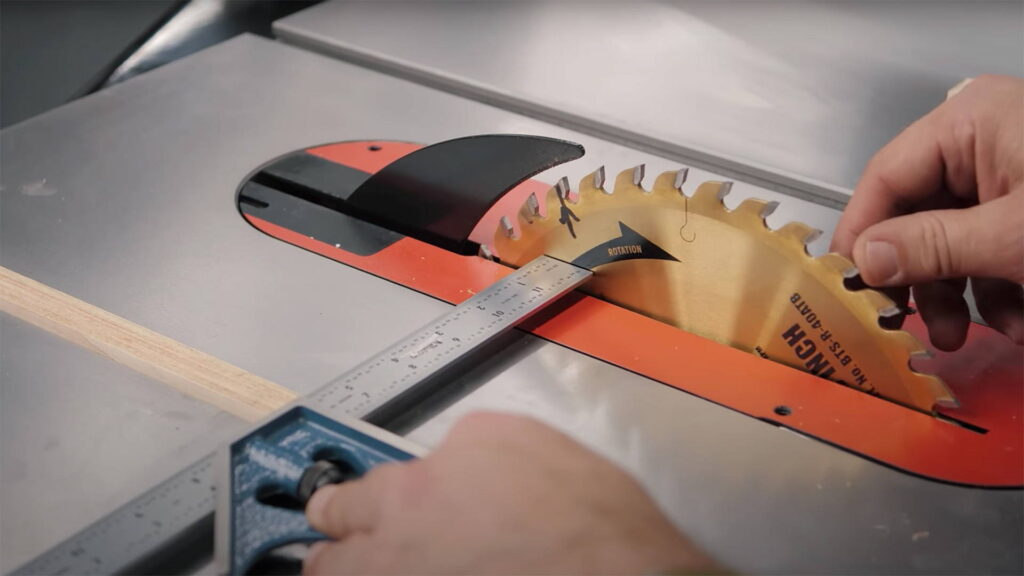
AOE provides high-performance machinery that allows operators across East Africa to use external micro-adjustment mechanisms for fine-tuning this alignment.
These systems reduce setup times and prevent melamine wastage on high-volume production lines by removing the need to open machine cabinets during the calibration process.
| Adjustment Technology | Setup Duration | Calibration Tolerance | Production Yield Impact |
|---|---|---|---|
| Internal Mechanical Shims | 15 – 25 Minutes | 0.10 mm increments | High waste during manual trial-and-error |
| External Micro-Adjustment Dials | 1 – 3 Minutes | 0.01 mm increments | Maximum yield via immediate zero-defect alignment |
Laminate Fracture Mechanics and the Engineering Purpose of Scoring Blades
Laminate blowouts occur when the main saw blade exits the bottom of a melamine-faced panel and tears the brittle surface layer instead of shearing it cleanly. Modern panel saw Kenya installations prevent this failure by pre-cutting a shallow, slightly wider kerf into the bottom laminate.
This action isolates surface tension. The main blade then severs the core material without exerting upward force on the finish layer. In regions with varying humidity like Nairobi or Mombasa, the stability of this score is vital for processing 18mm particleboard and MDF without edge degradation.
Precision Engineering of External Micro-Adjustment Systems
Industrial machinery replaces mechanical shims with external micro-adjustment technology to streamline floor operations. Workshop engineers rotate indexed dials located on the machine exterior to shift the scoring unit independently of the main spindle.
This design removes the requirement to disable power or access internal arbors during shifts. High-quality industrial saw blades perform more consistently when supported by these rigid, externally controlled housings.
Mechanical Components of External Adjustment Units
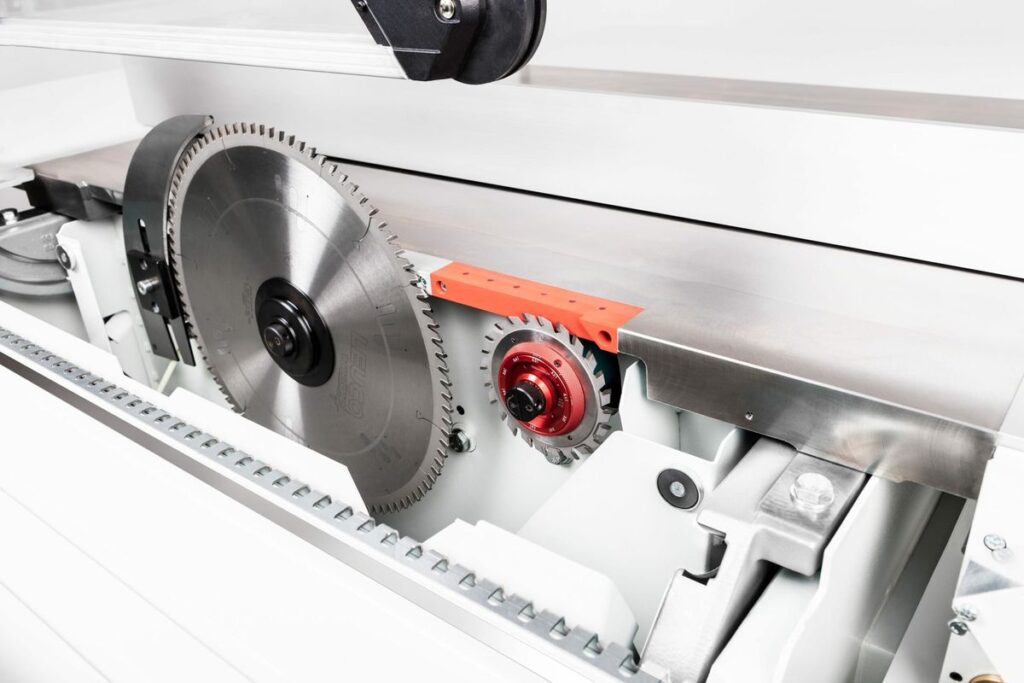
External adjustment systems utilize twin rotary controls to dictate lateral and vertical blade movement. The lateral dial shifts the axial position of the scoring blade by fractions of a millimetre to ensure concentricity with the main blade.
The vertical control determines the depth of the score cut. Operators maintain a shallow depth to preserve the carbide tips and prevent premature wear on the scoring unit.
Kerf Alignment Without Internal Machine Access
The scoring blade must align with the main blade to prevent stepped edges or offset chipping. Operators use external micro-adjustment knobs to align the kerf without opening the protective cabinet.
Turning these dials expands or contracts a split scoring blade to match the main kerf width. This process establishes immediate cut readiness while keeping machine guards closed and safety protocols intact.
Operational Economics of Precise Kerf Alignment
Rapid calibration systems lower overhead costs for East African furniture manufacturers by converting downtime into active cutting hours. Precise alignment reduces the reject rate of premium high-gloss and double-faced melamine panels.
High-volume factories achieve better material yield which justifies the investment in industrial panel dividing technology equipped with indexed adjustment units.
Training Protocols for Industrial Scoring Unit Maintenance
Machine operators require specific procedural knowledge to use adjustable scoring systems effectively. Floor managers should enforce maintenance and testing routines to sustain cut quality across multiple shifts.
Regular cleaning of the scoring arbor ensures that dust build-up does not hinder the responsiveness of the adjustment dials. For technical support, machine inquiries can be directed to the AOE support team for specific calibration guides.
Standardised Operator Training for Calibration
Training programmes instruct operators to execute a test cut on a scrap board and use tactile feedback to detect alignment steps. Supervisors teach staff how to translate this feedback into precise micrometre dial adjustments.
Standardising this diagnostic skill prevents operators from widening the kerf unnecessarily and protects the finish for the AOE edge bander to apply tape to a perfectly flat surface.
Daily Operating Procedures for Scoring Units
Workshops benefit from documenting SOPs for daily scoring blade calibration. Technicians mandate a visual inspection of the blade teeth followed by a depth-setting protocol of 1.5 to 2.0 millimetres into the board surface. Adhering to these parameters reduces human error during product changeovers between different board densities.
Maintenance Strategies for Scoring Performance
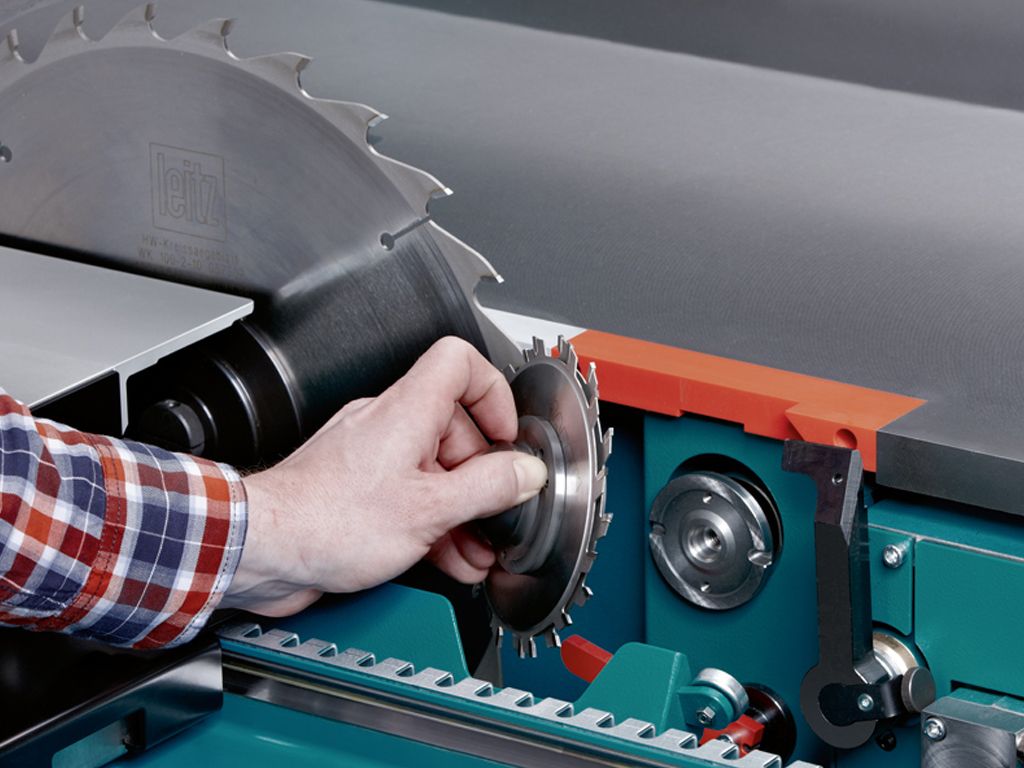
Resin and adhesive accumulation on the scoring unit restricts the lateral movement required for micro-adjustments. Maintenance teams schedule weekly cleaning cycles using industrial solvents to dissolve pitch from the adjustment shafts.
Proactive sharpening intervals prevent operators from incorrectly increasing blade depth to compensate for a dull cutting edge. If the scoring unit requires replacement, using a CNC nesting router for complex parts might be an alternative, though the panel saw remains the primary tool for high-volume straight cuts.
Return on Investment for High Precision Scoring Technology
Investing in machinery with external scoring adjustments provides financial returns through decreased material spoilage. East African manufacturers operating continuous production lines recover the cost difference of premium saws within the first year.
This technology supports mass customisation by allowing the machine to adapt to varying board thicknesses and textures within the same production cycle.
Troubleshooting Lateral Alignment and Cut Quality
Operators must diagnose the lateral alignment of the scoring blade if an edge bander rejects a panel due to a stepped edge. If the bottom face chips on one side of the cut while the other side remains clean, the scoring kerf is offset and requires a minor adjustment of the lateral dial.
Replacing dull scoring blades before they burn the core material prevents excessive strain on the main cutting unit and maintains the motor life of the panel saw.
Blade Selection for Diverse Laminate Applications
Engineers choose between split-scoring blades and conical scoring blades based on machinery capabilities and panel density. Split blades rely on external dials to widen the two halves to match the main blade kerf.
Conical blades alter their effective kerf width by raising or lowering the blade depth. This requires strict vertical dial management to ensure the width remains consistent throughout the production run.
AOE Engineering Recommendations for High Yield Factories
AOE integrates precision panel processing machinery engineered for the operational demands of manufacturers in Kenya, Tanzania, and Uganda.
Our technicians install machines featuring heavy-duty external micro-adjustment systems that withstand the vibrations of constant production. You can request demo or a machinery consultation Kenya to see how these systems improve output quality.
Upgrading to panel saws equipped with external micro-adjustment dials protects material margins. We recommend mandating daily calibration checks in production schedules to ensure the scoring kerf aligns with the main blade. This practice cements output quality and lowers machine downtime across the factory floor.