
Upgrading to a Nanxing CNC 6-sided drilling machine provides a technical solution to manual boring errors by automating depth calculations and spindle selections directly from digital design files.
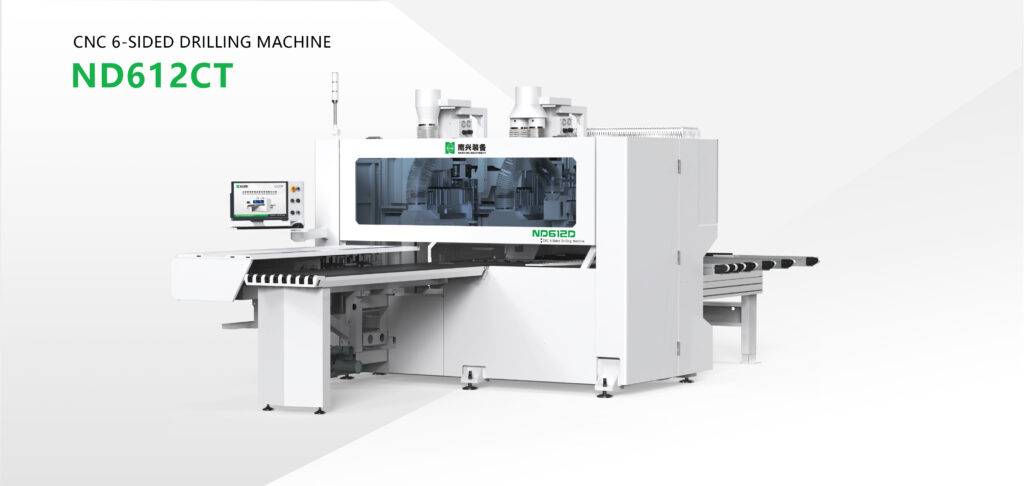
Factory owners and production managers in East Africa who partner with AOE to implement this technology bypass the high scrap rates associated with misaligned cam-and-dowel joints on expensive melamine boards.
Eliminating Manual Drilling Errors and Material Waste with Nanxing Technology
Traditional point-to-point drilling relies on operator measuring skills and manual machine calibration across multiple shifts. This manual intervention introduces offsets in hole positioning, which causes cabinet parts to fail during final assembly.
Removing physical measurement steps ensures absolute repeatability across high-volume furniture production runs. Manufacturers using 6-sided drilling technology maintain consistent quality regardless of operator experience levels.
| Feature | Manual/Point-to-Point Drilling | Nanxing CNC 6-Sided Drilling |
|---|---|---|
| Processing Speed | Requires multiple passes and manual flips. | Processes all six faces in a single pass. |
| Accuracy Level | Dependent on manual tape measurements. | Digital coordinate reading (0.05mm tolerance). |
| Labour Requirement | Highly skilled operator required for setup. | General operator for loading and scanning. |
| Waste Factor | High scrap risk on complex hole patterns. | Zero-defect output through barcode automation. |
Relying on tape measures and pencil marks increases the risk of ruined panels when processing expensive laminated boards. Automated drilling centres read digital coordinates directly from the design file, ensuring every dowel hole and hinge cup aligns on the first pass.
This precision removes rework from the daily production schedule and protects profit margins in competitive markets like Nairobi and Kampala.
Technical Capabilities and Automated Precision of Nanxing CNC Drilling Units
Human error in measuring drill depth ruins high-value melamine boards on the shop floor. The Nanxing intelligent control system reads the barcode generated by a CNC nesting router and sets the exact depth and spindle combination needed.
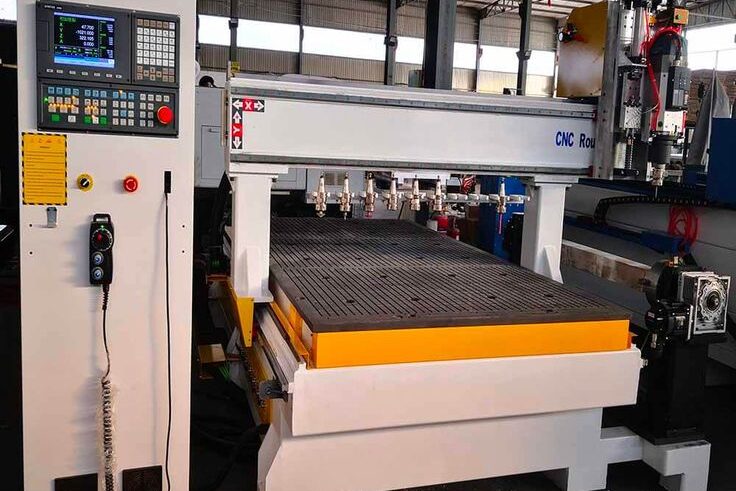
This automation removes reliance on operator guesswork during demanding, high-speed shifts. Operators scan the printed part label and feed the board into the machine. Automated grippers and servo-driven boring blocks execute complex hole patterns across all six faces of the panel.
The machine configures its vertical and horizontal drills to adapt to the specific hardware requirements of each individual component without manual tool changes.
Improving Production Throughput and Operational Efficiency in Panel Processing
Manual boring machines create bottlenecks in panel processing plants, forcing edge banding machines and assembly teams to wait for components.
A six-sided drilling setup processes all required faces and edges of a panel in a single pass without requiring the operator to rotate the material. This continuous feed mechanism increases parts-per-minute throughput for medium to large-scale factories.
Simultaneous top, bottom, and side drilling reduces machining time by more than half compared to traditional routing methods. Production managers can process entire kitchen batches quickly, keeping downstream assembly stations fully supplied.
This efficiency is critical for workshops meeting tight delivery deadlines for commercial fit-out projects.
Calculating Return on Investment through Error Elimination and Labour Efficiency
Scrapped melamine boards and repeated assembly rework erode workshop profit margins. The Nanxing CNC 6-sided drilling machine recovers these financial losses by ensuring a zero-defect drilling phase.
Factories reduce material waste and protect their raw material budgets immediately after installation. Automated systems also allow production engineers to use a furniture panel saw more effectively by planning more complex nested layouts without fearing drilling errors. Automating the boring process reduces the labour cost per part.
Floor managers can redirect skilled operators away from repetitive drilling tasks to critical quality control or advanced machine programming roles. This shift improves overall factory morale by reducing the physical strain associated with manual panel handling.
Factory Integration via Barcode Workflows and Scalable Production Methods
Integrating digital workflows transforms an isolated machine into a responsive production cell. Barcode-driven operations ensure that every panel carries its own machining instructions, which removes the need to manually input coordinates at the control console.
Operators manage the physical feeding while the software handles the spatial mathematics and positioning. This approach allows East African workshops to process complex, custom jobs with the same efficiency as large-scale batch orders.
Factories expand their product catalogues without worrying about overwhelming the drilling department with complicated hardware patterns. Precision is maintained across all six faces regardless of part geometry.
Regional Competitive Advantages for Manufacturers in East Africa
Finding and retaining skilled drill operators remains a challenge for manufacturers across Nairobi, Kampala, and Dar es Salaam. Automating the boring process mitigates the impact of regional labour shortages by shifting the skill requirement from manual machining to basic part handling.
New operators require minimal training to feed panels and scan barcodes. High-quality KWS tooling ensures that these machines maintain clean cuts through hundreds of cycles before requiring maintenance.
Workshops adopting this technology outperform competitors by delivering precision-engineered flat-pack furniture faster. Lowering the scrap rate strengthens a factory’s competitive pricing strategy in the local market. Digital precision also ensures that finished products meet international quality standards for export.
Technical Specifications for Production Engineering Planning
Evaluating technical specifications is critical for production engineers planning a machinery upgrade. Heavy-duty servo motors and rigid frame construction dictate the true output capacity of the equipment.
| Specification Feature | Technical Capability | Production Benefit |
|---|---|---|
| Boring Range (Sides) | Top, Bottom, and 4 Edges | Completes all hardware holes in a single pass. |
| Panel Dimensions | Min: 200x50mm | Max: 2800x1200mm | Accommodates drawer components and tall wardrobe panels. |
| Axis Drive System | High-Precision AC Servo Motors | Ensures sub-millimetre accuracy and rapid positioning. |
| Data Input System | Barcode Scanner & Network Link | Eliminates manual entry and prevents hole mapping errors. |
Drilling Accuracy and Z-Axis Depth Control Features
Precision Z-axis controls ensure drill bits penetrate to the exact millimetre specified in the furniture CAD CAM Kenya drawing. Laser sensors detect variations in panel thickness and adjust the drilling origin to prevent surface blowouts.
This dynamic adjustment maintains tight tolerances for minifix and dowel connections, which are essential for structural integrity in knock-down furniture.
Handling Diverse Panel Dimensions and Core Material Types
Modern panel processing requires equipment capable of managing MDF, particleboard, and solid core plywood. Dual gripper systems secure panels of varying dimensions to prevent lateral movement during horizontal boring operations.
The transport system moves narrow plinths and wide desktop panels through the machining zone without damaging sensitive edge bands or finished surfaces.
Software Integration and CAD CAM Data Pipelines
Post-processors translate cabinet design files into machine-readable code without manual conversion. This data pipeline removes the need for operators to interpret 2D paper drawings.
Software compatibility ensures the machine connects with industry-standard programmes to bridge the gap between the design office and the factory floor.
Maintenance Protocols for Long Term Operational Value
Industrial machinery in East Africa requires robust build quality to withstand dust ingress and heavy usage cycles. High-grade linear guideways and dust-protected bearing blocks extend the operational lifespan of the Nanxing drilling unit.
Centralised lubrication systems simplify routine maintenance by keeping moving parts greased and functional. Implementing daily cleaning and inspection routines prevents dust accumulation from fouling precision optical sensors.
Operators must adhere to scheduled tool replacement cycles to ensure drill bits remain sharp. Proactive care reduces unexpected breakdowns during peak factory production months and maintains the accuracy of the boring blocks.
Localised Technical Support and Training Provided by AOE in East Africa
Sourcing advanced CNC equipment requires reliable technical support to guarantee continuous factory operation. AOE technicians provide installation and calibration to handle local voltage variables and training for the software interface.
Holding critical spare parts locally means East African workshops avoid extended downtimes while waiting for international shipments. For a detailed assessment of your requirements, you may book a machinery consultation Kenya to see these systems in action.
Partnering with AOE for Nanxing CNC Integration and Success
Transitioning to automated boring requires an assessment of current production bottlenecks and future output goals. Engineering consultants at AOE analyse shop floor layouts to determine the optimal integration strategy for high-speed drilling systems.
Contacting our technical team initiates the process of engineering a more profitable and error-free panel processing line.
AOE Engineering Verdict: Investing in a six-sided drilling centre is a necessary upgrade for East African workshops experiencing high scrap rates from manual boring.
The elimination of measuring errors and the implementation of barcode-driven workflow automation deliver a measurable ROI by safeguarding raw materials and accelerating assembly times.